Creating rituals for the transitions of aging
Editor’s Note: This article appeared in eJewishPhilanthropy on February 1, 2026.
 Thanks to scientific and medical advances, the human lifespan is lengthening. More and more people live 30 years longer than earlier generations did. Those additional 30 years are not tacked on to the end of our lives, but rather during our active years. It is a new life stage, and people can’t agree on what to name it. Elderhood? Middlescence? The next to last dog stage? If you can’t name it, it is hard to see it. Yet it matters.
We face an unprecedented challenge as we are blessed with more years added to our life: How do we add more life to our years?
The Book of Psalms offers guidance: “Show us how precious each day is; teach us to be fully here” (90:12). In other words, pay attention.
We have learned in our hundreds of conversations with people in their late 40s through their healthy 90s that people ought to begin to think about the profound shift in our view of ourselves that takes place in midlife. One needs to pay attention — and to prepare — and rituals play an important role. Ritual is a tool, a technology, that helps us to pay attention. Through ritual we can connect more deeply to what matters in our life and appreciate that we are part of something greater than ourselves.
As Jews, we know of the significance of many different kinds of rituals, including rituals of transition when one moves from one life stage to another. We see many of these rituals in our early lives and we are struck by the absence of those rituals as we grow older. Some would argue that we relive them through our children and grandchildren. But not all of us have children or grandchildren; and some who do are not in the kinds of relationships with them that are loving, respectful and supportive.
The next traditional Jewish ritual that occurs after the ones of our adolescence and early adulthood is our funeral. Ironically, the span between early adulthood and our funerals will most likely be longer than the span from birth to early adulthood. And that span gets longer and longer as more of us live to be centenarians.
What are the important moments in this new stage of life — midlife and beyond — that will help us notice what really matters in our lives as we grow older? What are those transitions from one social role to another? How might we mark the moments that matter: retirement (or rejoining the workforce); making new friends and celebrating longtime friendships; renewing partnership vows; celebrating milestone birthdays?
Click here to continue reading.
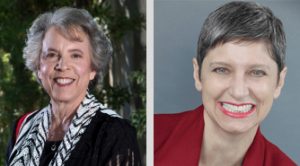
Rabbi Laura Geller is rabbi emerita of Temple Emanuel of Beverly Hills. She was the co-founder of ChaiVillageLA and is the chair of the Synagogue Village Network. Along with her late husband, RIchard Siegel z”l, she was the co-editor ofGetting Good at Getting Older (Behrman House, 2019), which was named a National Jewish Book award finalist.
Rabbi Beth Lieberman serves as adjunct faculty at Hebrew Union College – Jewish Institute of Religion. She was the literary editor of the JPS Hebrew-English Tanakh: Revised Edition (Jewish Publication Society, 2023).
