

Inter-Religious Collaboration: Make a Friend Before you Need a Friend
Editor’s Note: This article appeared in eJewishPhilanthropy on November 30, 2025.
My friend, Reverend Earl Harris, a former Christian pastor and veteran of the Civil Rights movement who comes to  our Shabbat services almost weekly, taught me that when it comes to inter-religious collaboration you need to, “make a friend before you need a friend.”
The truth of that teaching became clear after the firebombing attack on Pennsylvania Gov. Josh Shapiro’s residence on the first night of Passover last spring. The Governor’s Residence is a few blocks from my house and the synagogue where I work in Harrisburg. It was shocking to return from my family’s Passover Seder in Maryland and see the gates of the residence covered in caution tape and the block swarming with police cars.
As soon as the holiday was over, I reached out to other rabbis in town and asked what kind of response was being planned. To my surprise, I found that no plan had been formulated, so I took up the cause myself, convinced that the public needed to see a positive showing of interfaith support in Harrisburg to know that the community would not tolerate violent acts of hatred. Together with another rabbi and the local Jewish federation, we discussed ways that the community could respond to this shocking hate act. Then I began to reach out to my interfaith network.
I am fortunate to have strong relationships with leaders of other Harrisburg faith communities. The Harrisburg community has a long history of interfaith organizing that I inherited, from an interfaith “Freedom Seder” that my congregation hosts annually to a monthly Jewish-Christian Bible study group, as well as multiple interfaith programs and services throughout the year.
Having often participated in these events I had numerous contacts with interfaith clergy and friends that I could reach out to in a crisis. Once we set a date and a time for a solidarity march to condemn acts of hatred, I sent out requests to faith leaders in town to partner with me and the Jewish community in the event. Within a few days, I had a robust response from leaders across faith traditions, ready to march with us.
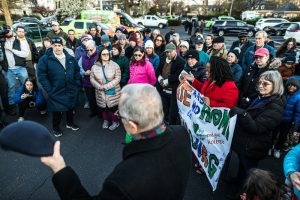 It wasn’t uncomplicated, of course. There were security issues to think of, a fear that is all too common for Jews these days. Might someone who heard about the march try to attack us? This was not an unreasonable fear, given that we were responding to exactly one such antisemitic attack. Fortunately, the Harrisburg police department agreed to accompany the march, attending to our security concerns.
But there were other issues, as well. One dear friend, an organizer in the Black community who I met at a Black Lives Matter rally, expressed concern that we would gather a large march to respond to an act of violence against a prominent, privileged member of our community when we had not done so after incidents of gun violence that affect poor and underprivileged community members. Gun violence in Harrisburg is disproportionately high and the need to organize and end it is urgent. My friend told me that he could not participate in the rally as I described it because it so heavily centered on Gov. Shapiro over needy people who so often go unnoticed.
I appreciated his perspective, and it helped me reframe the message of the rally. We called it, “Hate Has No Home in Harrisburg,” and, at the rally, we spoke about the need to end violence of all kinds, not just this firebombing but gun violence as well.
Click here to continue reading.
Rabbi Ariana Capptauber serves as the rabbi of Beth El Temple in Harrisburg, Pa., where she lives with her husband and two children.
